
Key sales and purchasing trends in this ready-to-wear market
Japan is not only one of the world’s largest ready-to-wear markets, but also one of the largest clothing importers. This market provides new development opportunities for fashion brands and retailers. Julia Huott and Sheng Lu from the University of Delaware conducted an in-depth study of Japan’s sales and purchasing models and some unique features.
Japan is one of the world’s largest ready-to-wear markets. Clothing market sales reached US$67 billion in 2018, second only to the European Union (US$380 billion) and the United States (US$284 billion). USD), ranked third.
Japan, like other developed economies, most of the local consumption of clothing comes from imports. This has made global fashion companies and purchasing agents see Japan as a country with huge procurement capabilities. power and marketing opportunities.
This in-depth analysis of the Japanese ready-to-wear market and its sourcing patterns, based on the latest market and trade data, will help fashion brands and retailers explore current and future business opportunities .
(1) Overview of Japan’s ready-to-wear market
The unique features of Japan’s ready-to-wear market.
First of all, the Japanese market is huge, but its growth is slow. During the period from 2015 to 2019, Japan’s annual clothing retail sales remained at around US$66 billion, with no significant increase or decrease. Similar to many other markets, of the ready-to-wear items sold in 2017, women’s clothing accounted for 62.1%, men’s clothing accounted for 29.0%, and children’s clothing accounted for approximately 9.0%.
Although the growth rate of the Japanese market is not as exciting as that of some emerging economies, the overall size of the Japanese garment market is still attractive. In 2018, the size of the Japanese market was almost the same as that of some emerging economies. India is as big as 123%, Mexico 433.2%, Brazil 283%, and South Korea 262.9%. Most importantly, as Japan’s economy gradually improves, the forecast states that Japan’s ready-to-wear retail market value is likely to climb upward at an annual growth rate of 1.3% over the next five years, reaching around US$71 billion by 2023. Despite this growth rate Still lower than the world average of 4.3% during the same period.
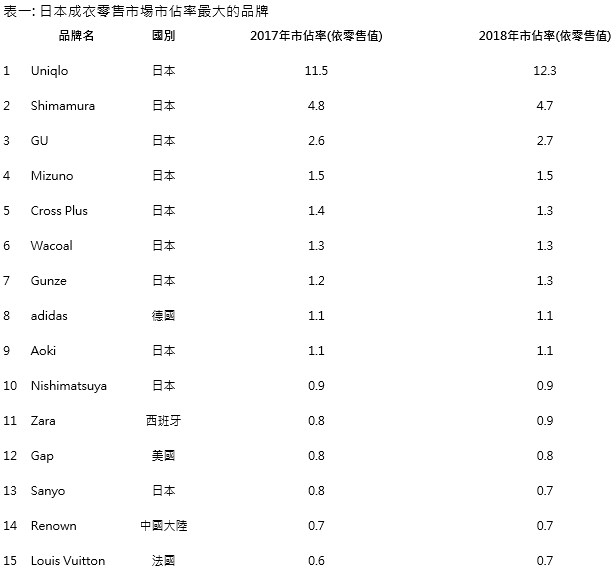
Secondly, the Japanese ready-to-wear market is highly competitive, with local brands being the main competitors. This market has more than 105 regional and global fashion companies stationed in Japan, including internationally renowned brands such as adidas, Zara, and Gap. However, what is unique about this market is that Uniqlo dominates the market among many Japanese brands, with its market share growing steadily from 8.5% in 2012 to 12.3% in 2018 (see Table 1). In comparison, Nike, the strongest brand in the U.S. ready-to-wear retail market, only accounted for 2.5% of the Japanese market in 2018, while other non-U.S. fashion brands are even more obvious.
This is an important reminder that even though Japan is highly influenced by Western culture, the average Japanese consumer still seems to prefer traditional and localized products. On the other hand, in Japan, fast fashion brands seem to be more popular and successful among consumers than luxury brands, which is significantly different from other Asian markets (such as China and South Korea) and European markets (such as Italy, France, and the United Kingdom).
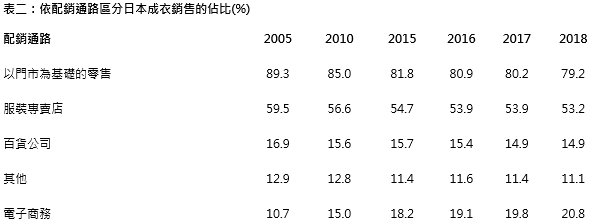
Third, despite the rapid growth of e-commerce, Japanese consumers still mainly shop in physical clothing stores. As shown in Table 2, ready-made clothing is mainly sold through a combination of traditional and new channels. But despite the increasingly fierce competition in e-commerce, retailers with traditional physical stores (such as clothing stores and department stores) still play a dominant role in the Japanese market. As of 2018, Japanese consumers purchase nearly 80% of clothing in physical stores. In comparison, only 20% of clothing in Japan was sold online in the same year, which is far lower than other nearby Asian markets, such as China (32%) and South Korea (29%). Japan’s unique consumer culture and social norms may contribute to continued strong performance of physical clothing stores.
(2) Japanese ready-to-wear purchasing model
There are three points worth noting about Japan’s ready-to-wear purchasing model :
First of all, Japan’s garment import value and consumption pattern have maintained steady growth. Specifically, according to data from the United Nations Commodity Trade Statistics Database (UNComtrade), compared with the same period last year, Japan’s total garment imports enjoyed a compound annual growth rate of 2.7% from 2010 to 2018, which was lower than that of the United States (3.4%) but higher than that of the United States (3.4%). EU (1.9%) and world average (1.3%). In terms of products, the import values of knitted garments (HS Chapter 61) and woven garments (HS Chapter 62) are almost the same. However, due to market demand, women’s clothing usually accounts for 60% of Japan’s garment imports, while men’s clothing accounts for 40%.
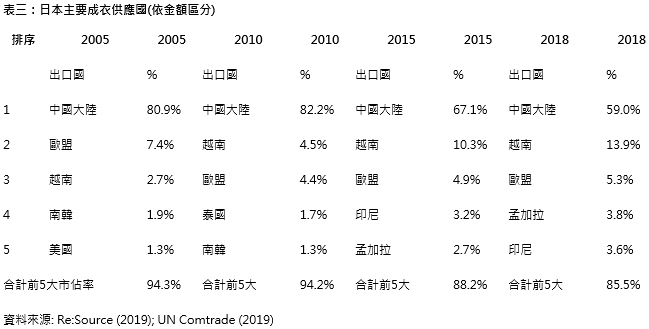
Secondly, although China is still Japan’s largest supplier of ready-made clothing, local fashion brands and retailers are also actively diversifying their supply. As shown in Table 3, since the quota system was abolished in 2005, China has an unprecedented market share of more than 80% in terms of value, and has long been Japan’s largest supplier of ready-made garments. However, as “Made in China” becomes more and moreThe more expensive it is, China’s market share in Japan’s ready-to-wear market has been declining in recent years, falling to a record low of 59% in 2018.
Similar to the situation in the United States and the European Union, Japanese fashion brands and retailers are also actively seeking other alternatives. Although Vietnam, Bangladesh, and Indonesia are still far behind China in terms of production capacity and market share, imports from these emerging countries are growing particularly fast. For example, Uniqlo, Japan’s largest ready-to-wear retailer, previously purchased nearly 100% of its products from China. However, since 2018, Uniqlo has actively carried out strategic development of production capacity in Vietnam, Bangladesh, Indonesia, India, and Turkey. As Japanese fashion companies diversify their supply sources, the total market share of the top five garment suppliers in terms of value dropped from 94% in 2005 to about 85% in 2018.
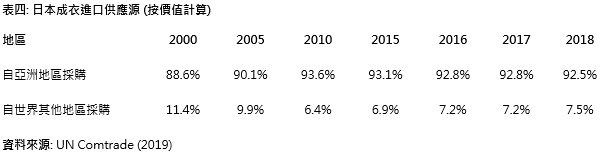
Third, more and more Japanese fashion companies are sourcing from Asia. As shown in Table 4, due to deeper integration of regional economies and more efficient regional textile and garment supply chains, the proportion of Japanese garment imports from Asia is increasing.
However, a large proportion of Japan’s ready-made garments imported from Asia actually contain fibers and yarns made in Japan. For example, it is not difficult to find clothing labeled “Made in China” or “Made in Vietnam”. The product details also include “Using soft, slow-spun Japanese fabric” and “Containing Japanese yarn”. “(WithJapaneseyarns) phrase.
The growing regional trading groups in Asia also pose unique challenges to other garment suppliers from around the world interested in the Japanese market. As of 2018, only 7.5% of Japan’s imported garments come from non-Asian countries (mainly Western European countries), which is a significant decrease compared with 11.4% in 2000.
(3) Tariff barriers and free trade agreements
Trade including tariff barriers and free trade agreements Policy is another key factor affecting the product sourcing of Japanese fashion companies.
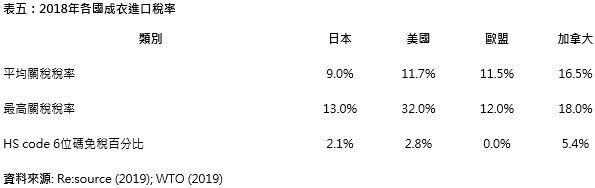
*Under Chapters 61 and 62 of HScode, the duty-free access to HS6-digit code product items accounts for the percentage of the total number of items.
In general, compared with other major importing countries, Japan has set lower tariff barriers for garments. As shown in Table 5, Japan’s average tax rate applied to garment products (Chapter 61 knitted and Chapter 62 woven) in 2018 was 9%, lower than the United States (11.7%), the European Union (11.5%), and Canada (16.5 %) set tariff rate. At the same time, its maximum applicable tax rate is 13%, which is also lower than the 32% in the United States and 18.0% in Canada.
Free trade agreements (FTAs) and trade preferential schemes (TPAs) provide important tax reduction opportunities for Japanese fashion companies. According to British media reports, as of September 2019, Japan has approximately 15 FTAs and TPAs in effect, and its member countries include several first-tier garment suppliers in Asia, such as Vietnam, Bangladesh, India, Indonesia, and Cambodia.
Most of these trade plans adopt so-called “fabric-forward” rules of origin [also known as “double conversion” rules of origin (double -transformation rules of origin), which means that fibers and yarns can be produced anywhere, but every fabric component used in garments must be formed within the free trade zone. This rule of origin is more relaxed than the “yarn-forward” typically required by U.S. or Canadian FTAs. Less restrictive rules of origin also enable Japanese garment companies to take full advantage of the tax breaks provided by these trade schemes and provide them with more flexibility in sourcing textile raw materials.
In addition, Japan also actively participates in the trilateral negotiations on the free trade agreement between China and South Korea and the multilateral negotiations on the Regional Comprehensive Economic Partnership (RCEP), which involves Japan, South Korea, China, the Association of Southeast Asian Nations (ASEAN) and other countries. Once agreed and implemented, these trade deals will provide an exciting new tax-saving sourcing opportunity for China, the world’s largest exporter of ready-made garments.
All in all, Japan’s ready-to-wear market and its purchasing patterns will continue to develop in the coming years. Factors such as the national economy, consumer shopping behavior and preferences, and the growth trajectory of the new free trade agreement will be key factors in shaping the future prospects of the Japanese market, especially as Asian garment suppliers find that Japan is actually a market with development potential .
AAAGFHTRYKUYIU7OUP
Disclaimer:
Disclaimer: Some of the texts, pictures, audios, and videos of some articles published on this site are from the Internet and do not represent the views of this site. The copyrights belong to the original authors. If you find that the information reproduced on this website infringes upon your rights and interests, please contact us and we will change or delete it as soon as possible.
AA