

The naming of Oxford cloth specifications should be based on the thickness of the raw materials. For example: 210D Oxford cloth should be made of 200D raw materials for warp and weft, so why not call it 200D Oxford cloth? Because the current international allowable error range of raw material thickness is +/-5%, it is generally called upward, which is called 210D.
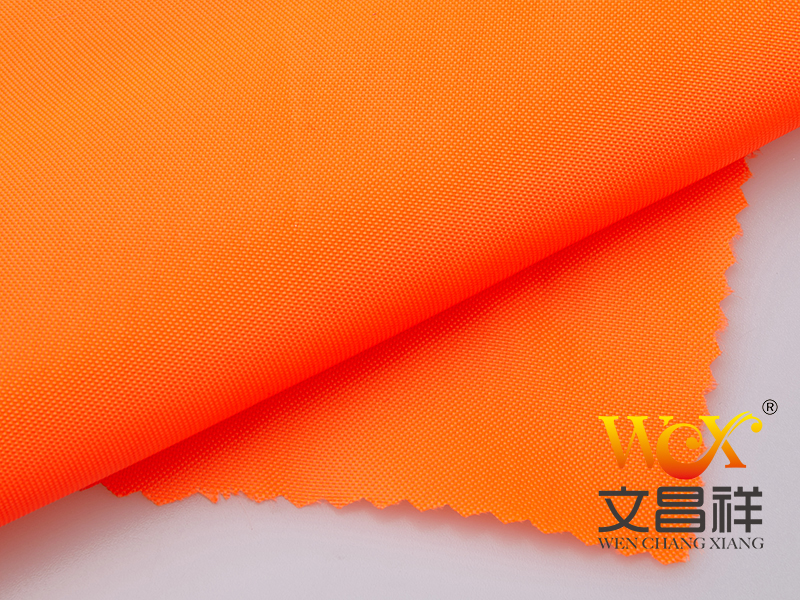
Some people now sell 150D Oxford cloth to customers as 210D Oxford cloth, or even sell 145D, 140D, and 135D as 210D. This is undoubtedly incorrect. Authentic 420D Oxford cloth should be woven from 400D raw materials, but many people in the market now use 300D and sell it as 420D Oxford cloth. The price of authentic 420D Oxford cloth is very different from that of 300D Oxford cloth. The thickness of the cloth is of course different. .
1680D luggage cloth should be woven from two 800D strands, otherwise it cannot be called 1680D luggage cloth.
In addition, the warp and weft density is also very important. It is also 210D. Some are dense and some are sparse. This is due to the difference in warp and weft density. , when buying Oxford cloth, you must pay attention to the warp and weft density. The warp direction generally talks about the number of steel reeds, the No. 12 reed is 12 threads per centimeter, the No. 12 reed is 24 threads per centimeter (12*2), the weft direction generally talks about the number of shuttles, that is, the number of yarns per centimeter. , which can be measured with a weft mirror. For example: 1200D12# reed with 7.5 shuttles, that is, 12 reeds in the warp direction, 1200D, and 7.5 reeds, 1200D in the weft direction.
Foreign countries often talk about how many T, such as 86T, 190T, 210T, etc., which refers to the range of 1 inch long and 1 inch wide. The sum of the number of yarns in the warp direction plus the number of yarns in the weft direction. For example: there are 46 roots within 1 inch in the warp direction and 40 roots within 1 inch in the weft direction, then it is called 86T. 1 inch = 2.54 centimeters.
In addition: yarn count is the thickness of yarn, and its expression methods include S, D, N, Tex, Dtex, etc. Specific fabrics have specific specifications, among which S and D are more commonly used.
D is: Denier (Denier):; a unit indicating density is the mass of yarn or fiber per meter Grams
The larger the D number, the thicker the fiber. For example, 600D Oxford cloth is thicker than 210D Oxford cloth
p>

24-hour customer service hotline: If you are interested in or have questions about Suzhou Textile Co., Ltd.’s Oxford cloth products, please contact the online customer service on the webpage, You can also leave a message or call the toll-free hotline: 400-8379793 to meet all your needs with the most dedicated service! </p