

If non-compliance is found after EU REACH registration, customs can directly ban the import of the product
Data collection under EUREACH has reached an important milestone between the implementation of the 2008 regulations and the last registration deadline in 2018.
It is reported that so far 15,000 companies have completed substance registration and submitted registration dossiers for 22,500 substances (approximately 100,000 copies).
However, collecting data in dossiers submitted by companies is only the first step in the layout of EUREACH regulations.
We know that in the full name of EUREACH:
“R” means registration of chemical substances ( Registered)
“E” refers to the registered substance evaluation (Evaluated)
Catherine was at the meeting It was emphasized: ECHA’s 2019-2023 strategic plan will focus on the dossier evaluation of registered substances, improve data compliance, and focus on the identification and risk management of substances.
This strategic plan is one of the important contents of the joint ECHA-Commission action plan between ECHA and the European Commissions. It was managed by ECHA in June 2019 Adopted unanimously and implemented by the committee, specific actions will be taken to promote compliance and involve all stakeholders.
Planning Points of ECHA Strategy
1. Change the previously determined 5% of the dossiers are selected according to each tonnage for compliance review, which has been increased to at least 20%, which is equivalent to evaluating 30% of the substances.
The extraction ratio of dossiers greater than 100t/a is about 35-40%, and the extraction ratio of dossiers less than 100t/a is about 20%.
2. Before the end of 2020, ECHA will complete the unified classification of substances containing 100+t/a in the submitted dossiers. At present, the EU officially divides all substances into three categories:
>>High priority-priority risk control substances
>>High priority – substances that require supplementary data
>>Low priority – substances that do not require further action
Substances not assigned to the above three categories belong to the “uncertain area”
3. Before the end of 2021, ECHA will develop Classification method for substances <100t/a to facilitate dossier compliance review.
4.ECHA plans to complete the compliance review of all dossiers >100t/a in 2023. The dossier review work for substances with a capacity of 1-100t/a will also continue until 2027.
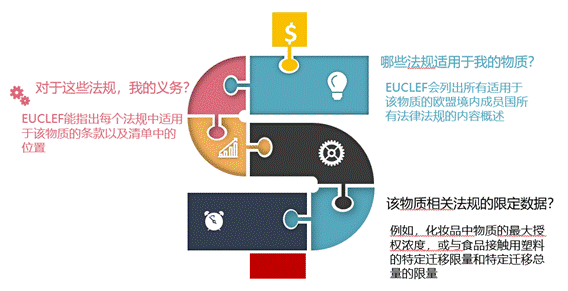
ECHA will launch a powerful search engine “EUCLEF” ECHA plans to launch the EU chemical regulations search engine (EuropeanUnionChemicalsLEgislationFinder) in 2020.
EUCLEF is mainly used for chemical regulatory information search, and will provide enterprises with one-stop regulatory navigation services for each substance-related EU member states. All regulatory information will be found above.
Most of the dossier reviews are non-compliant
According to statistics, those that have been completed in the past More than 2/3 of the files reviewed had at least one node that was not compliant and were required to supplement new data. The rate of non-compliance is very high.
If the information collected during the dossier evaluation proves that the substance is classified as carcinogen 1B, then the substance can no longer be produced.
The reasons for non-compliance may be analyzed as follows:
-
Inappropriate reasons for data exemption
-
Using non-testing methods (read -across, QSAR, weightofevidence methods) failed due to incorrect application of non-test methods and inappropriate reasons or lack of relevant documentation.
-
The documents submitted in the dossier are insufficient. For example, the robuststudysummaries are not written in detail enough, and the content is not sufficient to evaluate the node data results.
Which substances will be focused on?
-
Submitted substance dossier Has a higher tonnage
-
There are important data gaps in the dossier
-
Potentially high exposure exists in the following groups:
√Workers
√Consumer, or
√Environment
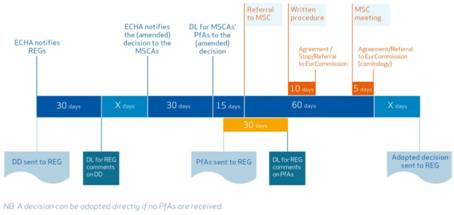
The following diagram shows the general process of dossier evaluation:
Customs will participate in joint law enforcement
According to the 2019 REF-7project, all 27 EU countries and the European Environment Agency will participate in this strategy.This action will strengthen cooperation between ECHA and national law enforcement authorities.
ECHA will provide information to member states to help member companies fulfill their obligations to renew registration. Member States take compilation and review measures for violations of dossier evaluation duties.
Strictly controlling imports and coordinating law enforcement with customs are priority implementation items from 2019 to 2023, and will focus on:
-
Cooperate with customs authorities to check registration obligations, identify and control imports
-
Verification of strictly controlled conditions related to intermediate registration
-
Dossier update obligation
If the company’s products are inspected at the border and are not compliant with EUREACH registration, even if the goods are already at the border , law enforcement agencies may require customs to stop future imports of the company’s products.
Suggestions
-
There is a high probability that a dossier of >100t/a will be reviewed by ECHA. Enterprises should be prepared for the dossier to be reviewed by ECHA.
-
At the same time, the enterprise and your OR need to work with the joint registrant to supplement the data and update the dossier and CSR based on the results of the review.
-
Please make a decision as soon as possible after receiving the draft resolution of the dossier evaluation whether to continue to use the registration number to share the subsequent additional data costs. Ruiou Technology will provide SIEF reports for companies to sign and make choices.
-
Enterprises are requested to proactively review and update the data information in the dossier.
AAAFGNHIYO
Disclaimer:
Disclaimer: Some of the texts, pictures, audios, and videos of some articles published on this site are from the Internet and do not represent the views of this site. The copyrights belong to the original authors. If you find that the information reproduced on this website infringes upon your rights and interests, please contact us and we will change or delete it as soon as possible.
AA